S1 · Historical account
S1 ↗National Park Service: Jefferson County Courthouse treason trials
Preserved source from the original Warfare file.
An armed labor uprising. A prosecution funded by coal. A jury that said not guilty.
THE MINE WARS
Illustrative reconstruction · figures in shadow · sound only in the filmOriginal Warfare editorial ratings /100 · not a CCS score. See Method & History.
 ILLUSTRATIVE RECONSTRUCTION, NOT A RECORD
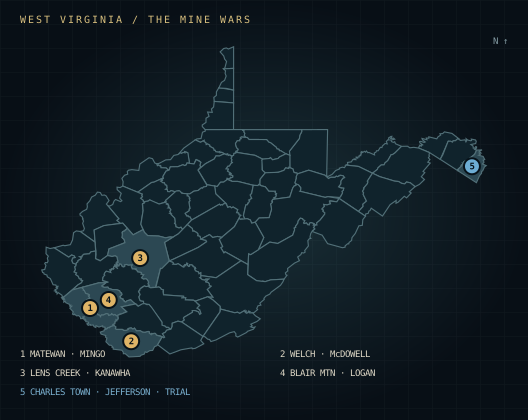
Shared Civic Ops county geometry · county-level locations · not troop positions, historical borders, or a compliance heatmap.
The miners won the trial. The coal companies won the war.
EDITORIAL INTERPRETATION · JURY VICTORY / INSTITUTIONAL AFTERMATHlawmen and strikebreakers under Sheriff Don Chafin at Blair Mountain, funded by the Logan County Coal Operators Association S4 ↗
privately hired planes dropping homemade bombs on the miners S4 ↗
miners indicted for murder, conspiracy and treason after the battle S4 ↗
coal-company lawyers running the prosecution: the miners called them the “Coal Dust Twins” S1 ↗
in legal fees the operators later billed to the state S1 ↗
armed miners at Blair Mountain (estimates run 7,000 to 13,000) S1 ↗
raised for the Miners Defense Fund S1 ↗
defense lawyers: T. C. Townsend, a former county prosecutor, and Harold Houston S1 ↗
union president, John L. Lewis, sitting at the defense table, not in the gallery S1 ↗
unexploded company bomb, recovered by miners and brought into court S1 ↗
Six original editorial ratings /100. Narrative game layer, not CCS, measured capability, or a validated probability model.
Baldwin-Felts detectives, private agents working for the coal operators, come to Matewan to throw union miners' families out of company houses. Police Chief Sid Hatfield and deputized miners meet them in the street. S4 ↗
Hatfield shoots Albert Felts. When the smoke clears, Albert and his brother Lee Felts are dead, along with Matewan's mayor, Cabell Testerman. S4 ↗
In January 1921, Hatfield and the other defendants stand trial for killing Albert Felts. All of them are acquitted. S4 ↗
dead in the street
of them company detectives
Hatfield and his friend Ed Chambers travel to the McDowell County courthouse to face new charges. A group of Baldwin-Felts agents is waiting, including Charlie Lively, a spy who had worked his way inside the union for the coal industry. S4 ↗
They shoot both men dead on the courthouse steps. One agent walks down the steps and shoots Chambers in the back of the head. S4 ↗
Mother Jones, 83 years old, tells the miners not to march into Logan and Mingo counties. She fears a bloodbath. They march anyway. S4 ↗
An estimated 13,000 men gather at Lens Creek Mountain and head for Logan County, where Sheriff Don Chafin runs the coal operators' anti-union operation. S4 ↗
men gathered at Lens Creek, by one estimate
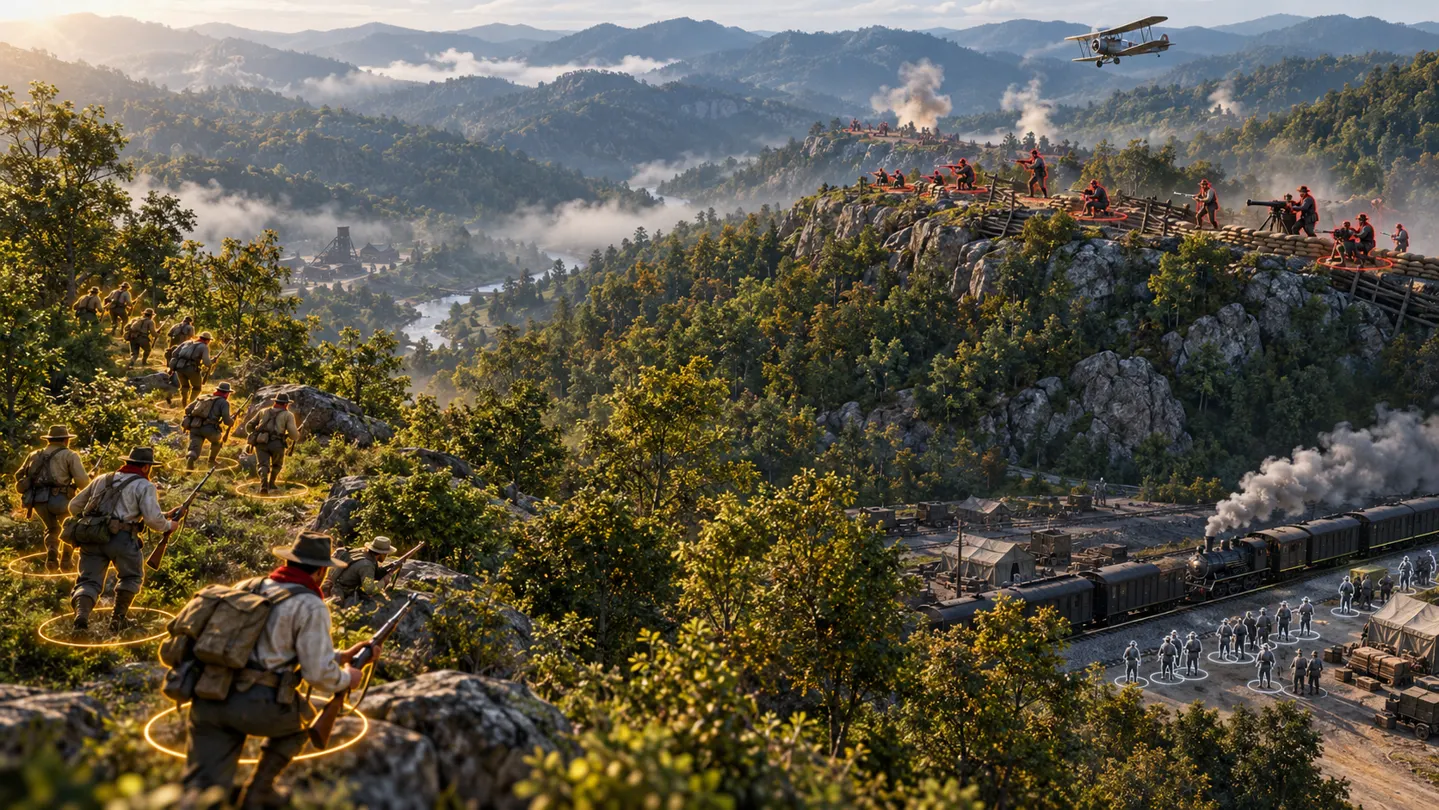
Chafin's forces dig in along the ridge: about 3,000 lawmen and strikebreakers, paid for by the Logan County Coal Operators Association. Both sides fire machine guns. S4 ↗
Privately hired planes fly over the miners and drop homemade bombs on them. President Harding orders federal intervention on August 30. Army bombers fly surveillance on General Billy Mitchell's orders, and one crashes on the way back, killing four of its five crew. S4 ↗
Federal troops arrive by September 2. Bill Blizzard tells the miners to go home. The death toll was never settled: accounts range from a handful to dozens on each side. S4 ↗
armed miners
Logan Defenders
days of fighting
The governor asks Washington to bring federal charges. The federal government says no. So West Virginia does it alone. S1 ↗
More than 500 miners are indicted for murder, conspiracy to murder, accessory to murder, and something almost nobody in American history has been charged with: treason against a state. Twenty members of UMW District 17 face the treason count. S1 ↗
miners indicted · some counts reach 985
charged with treason against West Virginia
The trials move to Jefferson County, more than 250 miles from the coalfields, with no coal mines of its own. The courthouse is the one where John Brown was tried for treason in 1859. S1 ↗
The local prosecutor, John T. Porterfield, steps aside, believing the charges are improper. Two private attorneys with close ties to the mine operators take over the case. The operators fund the prosecution and later send the state a bill for $125,000. The state attorney general never shows up. S1 ↗
prosecution fees billed to the state
raised by the miners' defense fund
Blizzard goes first. The whole trial turns on one question: was he at the head of the army when it reached Blair Mountain? S1 ↗
Former miners who flipped to the state swear he commanded the march, asked for reports and gave orders. Defense witnesses put him in Charleston, and others say he helped arrange the surrender. The defense's star witness is a U.S. Army infantry captain, who testifies he never heard the miners talk about going to war against the government. S1 ↗
Then the defense turns the air war around. One of the homemade bombs dropped on the miners never went off. The miners kept it, and it ends up in the trial as evidence against the government and the companies. S1 ↗
weeks of trial
Preserved source from the original Warfare file.
Preserved source from the original Warfare file.
Preserved source from the original Warfare file.
Preserved source from the original Warfare file.
Preserved source from the original Warfare file.
Preserved source from the original Warfare file.
Preserved source from the original Warfare file.
Ridge positions, private aerial bombs, and miners’ surrender to federal troops.
Coal-operator support and 3,000 recruited armed volunteers defending the ridge.
The miners approached a ridge held by Chafin’s recruited defenders, supported by the coal operators. NPS describes 3,000 armed volunteers. Federal soldiers intervened separately; miners surrendered to them rather than wage war against the federal government. S8 ↗ S9 ↗
The issue was Blizzard’s criminal liability for treason. Conflicting witnesses placed him with the marchers or in Charleston; his role in arranging surrender mattered to the defense. S1 ↗ S2 ↗
The National Park Service identifies the private prosecution lawyers, the defense fund exceeding $50,000, and $125,000 in legal fees billed to the state by the mine operators. S1 ↗
The original file distinguishes privately hired aircraft dropping improvised bombs from the Army’s later intervention. The unexploded-bomb episode remains part of the original narrative; inspect its supporting accounts rather than treating the artwork as evidence. S4 ↗
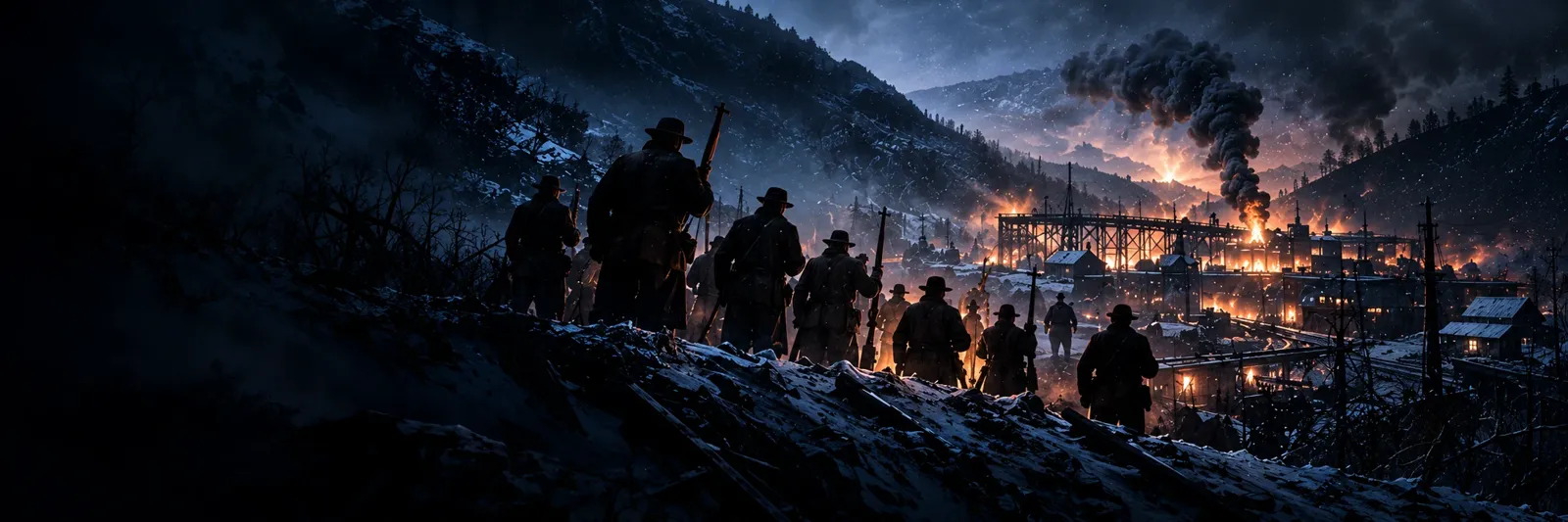 ILLUSTRATIVE RECONSTRUCTION
Name the exact claim and attach the source that supports a correction.
The campaign connects events and institutions. A trial acquittal does not establish a national appellate rule.
West Virginia used its criminal law to prosecute miners after federal charges did not materialize. Blizzard’s acquittal did not repeal that authority. S1 ↗
Control over employment, housing and anti-union operations connected private interests to public enforcement. The prosecution’s financing made the relationship visible. S1 ↗
Federal troops brought the armed confrontation to an end. The later state prosecution was a distinct exercise of authority. S1 ↗
The defense fund and union legal team supplied a route through the courtroom. Winning that case did not restore the union’s depleted treasury. S1 ↗
New Deal labor protections belong to the later institutional history. They were not powers created by Blizzard’s acquittal. S1 ↗
A fictional composite of phases, not a single historical moment. Terrain, unit numbers, placements, approach paths and the railway staging scene are imagined for visual explanation; this is not a tactical simulation or georeferenced battle map. Federal arrival is shown separately from the ridge fighting.
Documented basis: miners confronted Chafin’s defenders along the ridge; private aircraft dropped bombs; federal intervention ended the fighting, and miners surrendered. The gold, red and slate highlights identify forces, not constitutional-compliance assessments. NPS · Battle ↗ NPS · Chafin ↗
Shared Civic Ops county geometry · county-level locations · not troop positions, historical borders, or a compliance heatmap.
| Place | Role in the campaign | Record |
|---|---|---|
| Matewan · Mingo County | 1920 confrontation and company-house evictions | S4 ↗ |
| Welch · McDowell County | Hatfield and Chambers killed at the courthouse | S4 ↗ |
| Lens Creek · Kanawha County | Miners assemble for the march | S4 ↗ |
| Blair Mountain · Logan County | Ridge fighting and federal intervention | S4 ↗ |
| Charles Town · Jefferson County | 1922 treason trial, far from the coalfields | S1 ↗ |
 ARCHIVAL RECORD
A Cabin Creek miner, convicted of treason and sentenced to ten years. Released on a $15,000 bond, he skipped it. Officers traced him to Oklahoma City; by February 1923 he was reported in Mexico City. S5 ↗
A preacher who led miners against the ridge. He and his two sons were convicted of second-degree murder. S2 ↗
District 17's president. His trial was moved to Morgan County, and he was cleared of treason. S2 ↗
The trials drained District 17's treasury. UMW membership fell from more than 50,000 to about 10,000, and southern West Virginia wasn't organized until 1935, under the New Deal. S1 ↗
Retained from Claude’s Warfare build. An illustrative opening-day game device, with no validated statistical model. It is not a historical probability or forecast.
The original twelve numbers are preserved without rescoring. They are comparative narrative devices, not canonical battle-power or CCS assessments.
Six original editorial ratings /100. Narrative game layer, not CCS, measured capability, or a validated probability model.
Where sources disagree: miners at Blair Mountain (7,000 to 13,000 reported); indictments (NPS: over 500; other accounts: 985); the verdict date (e-WV and WVPB: May 27; NPS: May 25); deaths at Blair Mountain are disputed and were never counted. Power ratings and opening odds are CIVIC³ editorial scores. The card uses May 27 for the verdict; NPS gives May 25. S1 ↗ S2 ↗
Claude’s seven-round account, six ratings, 22% opening odds, verdict and aftermath remain in the original film.
Reconciled the prior blueprint and approved visual direction into the Card Standard 2.1 engine. Added reusable overview, gallery, powers and geographic components. Historical text and the original film are retained. Approved figure of 153+ retained as a reported total, with its unresolved accounting disclosed below.
The unsupported 153+ headline was replaced with NPS’s 3,000 recruited ridge volunteers. Editorial quote marks were removed. The battlefield illustration distinguishes gold miners, red company-funded ridge defenders and neutral slate federal arrivals, and is labelled a fictional composite rather than an exact record.
| Scope / event | Retained figure | Accounting status |
|---|---|---|
| Earlier campaign-wide claim | 153+ · unverified | Removed from the header. No source ledger was recovered; excluded from any verified total. |
| Matewan · May 1920 | 10 in the original narrative | A specific event count; not the whole campaign. S4 ↗ |
| Hatfield and Chambers · August 1921 | 2 named deaths | A distinct incident; not a count of the wider conflict. S4 ↗ |
| Blair Mountain · August–September 1921 | Disputed; no reconciled total | The original file says deaths were never counted. Scope and estimates require reconciliation. S4 ↗ |
| Federal aviation crash | 4 in the original narrative | A separate incident that must be classified before aggregating. S4 ↗ |